


Looking for Kathak classes for kids in Dallas? Discover the benefits of Kathak dance, what children learn, performance opportunities, and how to choose the right Kathak program.
Why Dallas Parents Are Enrolling Their Kids in Kathak in 2026
Dallas has evolved into one of the most culturally vibrant cities in the United States, home to a rapidly growing South Asian community that is deeply invested in preserving heritage, language, and the performing arts. Across neighborhoods like Plano, Irving, Frisco, and Sugar Land, Indian classical dance — especially Kathak — has seen a remarkable revival among the second-generation diaspora.
But Kathak is not just for Indian families. Dance studios, cultural centers, and online platforms have reported a surge of interest from parents across ethnic backgrounds who recognize Kathak as a rigorous, expressive, and truly enriching art form for children. Whether your child is four years old or fourteen, whether you are looking for an in-person class or a certified online instructor, this guide gives you everything you need to make an informed decision in 2026.
| Nayku Tip: Nayku connects Dallas families with certified Kathak instructors through live, one-on-one and group online sessions. Browse instructor profiles and book a free trial at nayku.com. |
What Is Kathak? A Quick Introduction for Parents
Kathak is one of the eight classical dance forms of India, originating in the courts of North India and deeply influenced by both Hindu devotional traditions and the refined aesthetics of the Mughal era. The word 'Kathak' comes from the Sanskrit word 'katha,' meaning story, and the dance form is built around the idea of storytelling through movement, rhythm, and expression.
Unlike many Western dance forms that emphasize pure physical technique, Kathak is a holistic discipline. It encompasses three core pillars:
- Nritta (pure dance): Abstract footwork patterns (tatkar), spins (chakkar), and hand gestures performed in strict adherence to rhythmic cycles called taal.
- Nritya (expressive dance): Abhinaya, or facial and gestural expression, used to portray emotions and narrate mythological stories often drawn from the Ramayana, Mahabharata, and the Bhagavata Purana.
- Natya (dramatic element): The theatrical and dramatic quality of performance, combining music, poetry, and dance in a unified artistic experience.
Children who study Kathak do not merely learn to dance — they learn to communicate, to listen to music, to count rhythm, and to connect with a cultural heritage that spans thousands of years.
The Right Age to Start Kathak Classes for Kids
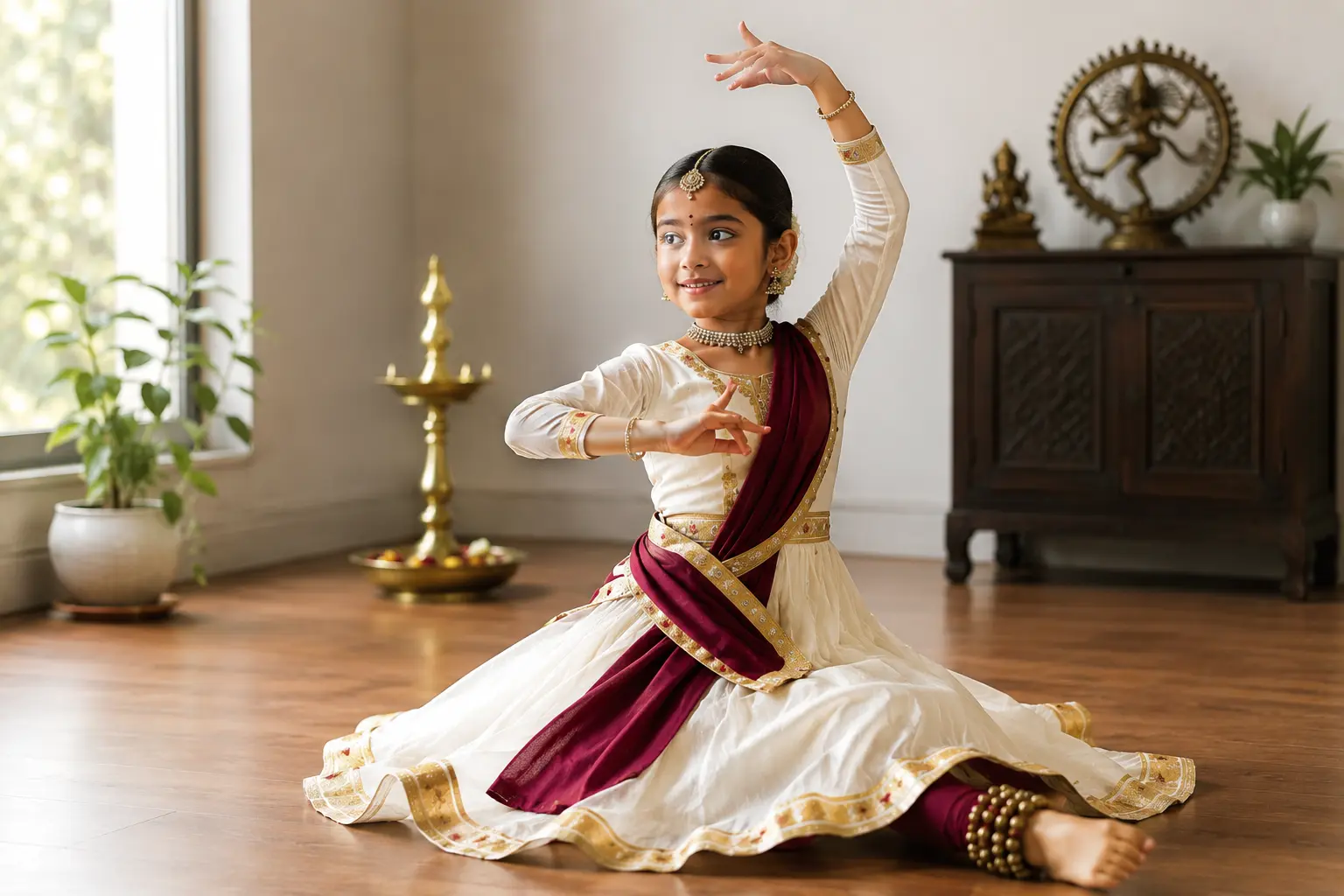
One of the most common questions Dallas parents ask is: how young is too young? The honest answer is that it depends on the child and the program, but most experienced Kathak teachers agree on the following general guidelines:
Ages 3–5: Pre-Kathak and Movement Awareness
Very young children are not developmentally ready for the technical demands of classical Kathak training. However, a growing number of studios and online platforms — including Nayku — offer pre-Kathak programs that introduce toddlers and preschoolers to rhythm through clapping, simple footwork, and folk-inspired movement. The goal at this stage is not technique but joyful engagement with music and movement.
Ages 5–7: Ideal Starting Age
The majority of certified Kathak instructors recommend beginning formal training between ages five and seven. At this stage, children can follow multi-step instructions, memorize short compositions, hold focus through a 30-to-45-minute class, and begin developing the physical coordination that Kathak requires. Starting early also means the child's body adapts naturally to postures and footwork before habits are formed elsewhere.
Ages 8 and Above: Never Too Late
Children who begin Kathak at age eight, ten, or even in their early teens can absolutely progress to a high level of proficiency. Learning at an older age comes with cognitive advantages — older children often grasp rhythmic theory and compositional structure faster than younger beginners. What matters most is not when training starts but how consistent the practice is.
What to Expect in Kathak Classes for Kids: A Curriculum Overview
Kathak training for children follows a structured progression that may span several years depending on the pace of learning. Here is what a typical beginner-to-intermediate curriculum looks like:
Year 1: Foundations
- Namaskaar (salutation to the guru and the audience) — the ritual opening of every Kathak session
- Basic taal recognition: Teen Taal (16 beats), Dadra (6 beats), Keherwa (8 beats)
- Tatkar — fundamental footwork patterns performed standing in place, building rhythm and stamina
- Basic hastas (hand gestures) including Pataka, Tripataka, and Kartarimukha
- Simple tukda compositions — short rhythmic sequences performed to a given taal
- Introduction to ghungroos (ankle bells) toward the end of the first year
Year 2–3: Intermediate Development
- Chakkar (spins) — an iconic element of Kathak, introduced gradually as the child's balance and core strength develops
- Tode and tukde — more complex rhythmic compositions with greater speed and articulation
- Vandana (invocatory piece) in honor of Ganesha or the guru
- Abhinaya practice — expressive pieces often set to bhajans or thumri
- Sequence memory — longer compositional forms that require sustained concentration
Year 4 and Beyond: Advanced Study
Advanced Kathak students work on extended compositions such as teen taal bandish, complex layakari (rhythmic variations), and full abhinaya recitals. Many students in Dallas at this level prepare for formal examinations through bodies recognized by India's Sangeet Natak Akademi or pursue bharatanatyam and Kathak in parallel.
| Nayku Feature: All Kathak instructors on Nayku follow structured syllabi and provide parents with regular progress updates. You can track your child's milestones directly in the app. |
Benefits of Kathak for Children: Beyond the Dance Floor
The benefits of enrolling your child in Kathak classes extend far beyond cultural connection or stage performance. Research in developmental psychology and arts education consistently shows that structured classical dance training produces measurable gains across multiple domains:
Physical Development
- Builds core strength, flexibility, and cardiovascular endurance through consistent footwork and spins
- Improves postural alignment — Kathak is performed from an upright, centered stance that counteracts the forward slouch common in screen-heavy children
- Enhances fine motor control through intricate hand gesture sequences
- Develops bilateral coordination — essential for sports, writing, and musical instrument training
Cognitive and Academic Benefits
- Learning rhythmic cycles (taal) builds mathematical intuition — children learn to divide and subdivide beats into fractions
- Memorizing compositions and sequences strengthens working memory and executive function
- Listening to classical music and understanding its structure supports phonological awareness and language skills
- The discipline of consistent practice — showing up, repeating, correcting, improving — directly translates to academic habits
Emotional and Social Growth
- Abhinaya training develops emotional literacy and empathy — children practice expressing joy, sadness, wonder, and devotion through facial expression and gesture
- Group class environments build social skills, cooperation, and the ability to perform in front of others
- Performance preparation builds stage confidence and reduces public speaking anxiety
- For children of Indian heritage in Dallas, Kathak provides a tangible, embodied connection to cultural identity that no heritage language class or temple visit alone can replicate
In-Person vs. Online Kathak Classes for Kids in Dallas
Dallas families in 2026 have more choice than ever. Here is an honest comparison to help you decide what format suits your child and your schedule:
| Factor | In-Person (Dallas Studios) | Online (Nayku & Platforms) |
| Instructor Quality | Varies by studio; local availability limits choice | Access to top certified gurus across India and the US |
| Scheduling | Fixed class slots; commute required | Flexible; sessions at your preferred time |
| Cost | $80–$150/month typical | Competitive rates; no travel cost |
| Interaction | Physical correction and social presence | Live video; personalized feedback |
| Performance Opportunities | Annual recitals, local festivals | Virtual showcases; regional event prep |
| Best For | Children who thrive in group settings | Busy families; quality-first approach |
How to Choose a Kathak Instructor for Your Child
Whether you are looking online or locally in Dallas, here are the key criteria to evaluate before enrolling your child:
- Formal training and credentials: Has the instructor received training from a recognized Kathak institution or guru? Look for affiliations with gharanas (the Jaipur, Lucknow, or Benaras traditions) or certifications from bodies like Pracheen Kala Kendra.
- Teaching experience with children: Adult Kathak training and child pedagogy are very different skills. Ask specifically about the instructor's experience with the age group of your child.
- Structured curriculum: A serious instructor should be able to outline what your child will learn in the first three to six months. Avoid programs that are vague about progression.
- Trial class availability: Any reputable instructor — including all instructors on Nayku — will offer a trial or introductory session so your child can assess fit before committing.
- Parent communication: Ask how the instructor communicates progress to parents. Regular feedback and milestone updates are a sign of a professional approach.
- Performance philosophy: Some instructors prioritize exam preparation; others focus on performance, expression, or cultural connection. Make sure the instructor's philosophy aligns with your family's goals.
| Start on Nayku: Every Kathak instructor on Nayku has a verified profile with credentials, student reviews, and sample class videos. Book a free trial at nayku.com. |
Cost of Kathak Classes for Kids in Dallas: What to Expect in 2026
Cost is a practical consideration for every family. Here is a realistic breakdown of what Kathak classes for kids typically cost in Dallas and through online platforms in 2026:
- Group classes at local Dallas studios: $80–$120 per month for weekly 45-to-60-minute sessions
- Semi-private lessons (2–3 students): $100–$150 per month
- Private one-on-one instruction (in-person): $120–$180+ per month
- Online group classes (Nayku and similar platforms): $60–$100 per month
- Online private lessons: $80–$140 per month depending on instructor seniority
Additional costs to budget for include ghungroos (ankle bells, typically $15–$40 for a child-sized pair), performance costumes for annual events ($60–$200), and any exam fees if your child pursues formal certification. Many platforms including Nayku offer the first trial class at no charge, so there is no financial risk in exploring your options.
Kathak and the Indian Diaspora in Dallas: A Cultural Perspective
Dallas-Fort Worth is home to one of the largest and fastest-growing Indian-American communities in the United States. The DFW metro area's South Asian population has grown significantly over the past decade, with particularly dense concentrations in Plano, Frisco, Carrollton, and Irving. Cultural organizations, temples, and community centers across these neighborhoods regularly host Garba nights, Diwali festivals, and classical music concerts — events that draw thousands of families each year.
For second-generation Indian-American children growing up in Dallas, Kathak offers something that no classroom subject can: an embodied experience of cultural identity. Learning to perform a thumri or a devotional vandana in front of an audience is not just a dance recital — it is an act of cultural continuity. Parents across the diaspora consistently report that classical dance training deepens their children's pride in their heritage, improves their relationship with their grandparents, and gives them a sense of belonging that is both personal and communal.
At Nayku, we understand this deeply. Our platform was built to serve Indian diaspora families across the United States who want access to authentic, high-quality instruction in classical arts, yoga, and wellness — without geographic compromise. Our Kathak instructors include gurus trained in the Jaipur and Lucknow gharana traditions who bring decades of performance and teaching experience to every live session.
Frequently Asked Questions: Kathak Classes for Kids in Dallas
Q1. What is the right age for kids to start Kathak classes in Dallas?
Most Kathak teachers in Dallas recommend starting between ages 5 and 7. At this age, children have developed enough coordination and attention span to follow choreography, understand rhythm (taal), and memorize short compositions. Some studios offer pre-Kathak movement classes for children as young as 3 to 4 years old to build awareness of rhythm and body movement before formal training begins.
Q2. How much do Kathak classes for kids cost in Dallas in 2026?
Kathak classes for kids in Dallas typically range from $80 to $180 per month depending on the format. Group classes at local studios usually cost $80–$120/month for weekly sessions. Semi-private lessons range from $100–$150/month, while private one-on-one instruction can cost $120–$180/month or more. Online platforms like Nayku offer flexible pricing with certified instructors, often at lower rates than in-person-only studios.
Q3. Do kids need prior dance experience to join Kathak classes?
No prior dance experience is required. Kathak is often a child's first structured dance form. Beginner-level programs in Dallas and on online platforms like Nayku are designed for complete beginners. Children start with basic footwork (tatkar), simple hand gestures (mudras), and introductory compositions before progressing to more complex bols and abhinaya.
Q4. What should kids wear to Kathak classes?
For beginner Kathak classes, children can wear comfortable, flexible clothing such as churidar-kurta sets or leggings with a tunic. As they advance, a traditional Kathak costume — including a ghagra-choli for girls or dhoti-kurta for boys — is worn during performances and exams. Ghungroos (ankle bells) are introduced once the student demonstrates stable footwork and is ready to practice with rhythm instruments.
Q5. Are online Kathak classes effective for kids in Dallas?
Yes, online Kathak classes have proven highly effective for children, especially for families in Dallas who want access to top-certified instructors without geographical limitations. Platforms like Nayku connect students with experienced Kathak gurus who conduct live, interactive sessions. Children benefit from personalized feedback, flexible scheduling, and consistent instruction — all from the comfort of home. Many students who started online have gone on to perform at community events and pass recognized examinations.
Q6. What are the benefits of Kathak for children?
Kathak offers a wide range of physical, cognitive, and cultural benefits for children. Physically, it builds coordination, flexibility, posture, and cardiovascular stamina. Cognitively, learning complex rhythmic patterns and compositions enhances memory, concentration, and mathematical thinking. Culturally, Kathak connects children of Indian heritage to their roots through classical stories, mythology, and traditional music. It also builds stage confidence, discipline, and emotional expression through abhinaya.
Q7. How long does it take for a child to learn Kathak?
Kathak is a lifelong art form, but children typically show visible progress within 3 to 6 months of regular practice. Most students are ready for their first performance piece within the first year. With consistent practice two to three times per week, a child can reach an intermediate level in approximately 3 to 4 years.
Q8. Can kids in Dallas find certified Kathak instructors online?
Absolutely. Platforms like Nayku (nayku.com) feature certified Kathak instructors available for live online sessions. This allows children in Dallas — and across the United States — to access trained gurus based in cities like New York, Chicago, or even India, without any compromise on quality. Parents can view instructor profiles, credentials, and student reviews before booking a trial class.
Find Certified Kathak Instructors for Your Child on Nayku
Nayku is an all-in-one platform built for families who want the best in online tutoring, classical arts, yoga, and wellness — all in one place. Our Kathak instructors are rigorously vetted, deeply experienced, and passionate about working with children. Whether you are in Plano, Frisco, Irving, or anywhere across the Dallas-Fort Worth area, your child can start their Kathak journey today.
- Live, one-on-one and small group Kathak sessions for all age groups
- Certified instructors trained in Jaipur, Lucknow, and Benaras gharanas
- Flexible scheduling to fit school and extracurricular routines
- Progress tracking and regular parent communication
- First trial class free — no commitment required
Book your child's free trial class today at nayku.com
Ready to Take the Next Step?
Connect with verified experts across 50+ service categories and get things done — fast.